
 By News Editor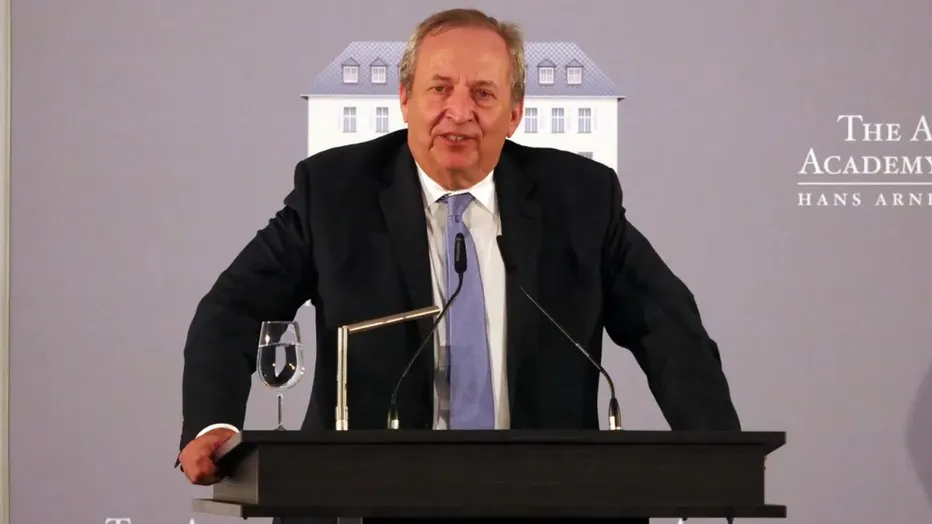
When communications linking powerful elites to Jeffrey Epstein began to surface publicly—through court filings, investigative journalism, and renewed scrutiny of Epstein’s network—many public figures experienced a sharp contraction in mainstream media access. Invitations slowed, interviews vanished, and reputational distance became the unspoken rule. Even those with mild associations, like Noam Chomsky to whom, Epstein provided dubious financial services in what appears to be an unlicensed manner.
One notable exception was Lawrence H. Summers who, like Milton Friedman and other conservative economic thinkers before him, enjoyed a privileged position within the economic elite and media power of the United States.
In the case of Bloomberg News, one of the U.S. most prestigious outlets for economic related content, Summers continued to be a valued and paid content partner.
Despite documented disclosures that placed Summers among those who had contact with Epstein after Epstein’s 2008 conviction, Summers continued to appear regularly across Bloomberg News platforms weeks before it was revealed that Summers asked Epstein for dating advice via email.
In the elite polite circles of New York, the strictest standards are upheld. Even the appearance of impropriety are serious ethics violations in the financial services world, unless, of course, you are rich and white. Lawrence Summers proved how exceptional he was with every appearance in Bloomberg News. We counted over 69 of them, but this is a mere estimate. After all, Summers basically appeared weekly on the Wall Street Week podcast starting sometime in 2024.
Curiously, the man offers no charisma, no particularly profound accolades on any topic and he wasn’t particularly well liked in the company or outside of it. What a curious move for a company with such a protective stance on its brand representation. What gives?
At any rate, Summers was offering commentary on inflation (March 2025), labor markets, fiscal policy, and foreign policy and U.S. elections – the man had range, apparently. An intellectual tour de force if we take that dry and pedestrian commentary that Bloomberg News could just not resist at face value.
No degree on pedagogy or education? No problem, Summers could even comment on Harvard reforms just as the Trump administration pressed on the most treasured assets of the country: academic freedom.
Regardless of whether he was the correct source, an undeniable truth now is that Bloomberg News managed to platform a pedophile’s sidekick nerd friend for decades. I suppose the only people who wouldn’t consider this detail as part of their potential purchase of the company – yes, Bloomberg LP is for sale – are JP Morgan since they had their own dealings with Mr. Epstein. This continuity raises a difficult but necessary question: why did Summers make so many Bloomberg appearances after the first tranche of Epstein-related communications were revealed in 2023—and what does that say about elite media norms?
Establishing the Timeline
The key disclosures relevant to Summers emerged in 2019–2021, when:
- Epstein’s financial and social networks were re-examined following his 2019 arrest and death.
- Media reporting confirmed that Summers had acknowledged meetings with Epstein after Epstein’s conviction, stating they occurred in the context of philanthropic and academic fundraising.
- Court documents and reporting expanded the list of elite figures whose Epstein associations had not previously been widely scrutinized.
By mid-2019, Epstein’s name had become radioactive in public discourse. From that point onward, many figures—even those without allegations of wrongdoing—were quietly deprioritized by major outlets.
Yet Bloomberg continued to feature Summers prominently.
Estimating Bloomberg Appearances (Post-Disclosure)
Because Bloomberg does not publish a single public index of guest appearances across Bloomberg TV, Bloomberg Radio, Bloomberg Opinion, Bloomberg Surveillance, and Bloomberg Podcasts, any figure must necessarily be an estimate based on observable output. However, a simple Google search will yield pages upon pages of results in YouTube/Bloomberg News appearances and their primary site, too.
A conservative estimate suggests that between 2019 and 2024, Lawrence Summers appeared on Bloomberg platforms between 60 and 90 times, including:
- Dozens of live or recorded TV interviews for his corny podcast.
- Frequent repeat appearances during inflation cycles (2021–2023)
- Regular quotation or commentary as a “former Treasury Secretary” or “Harvard economist”
- Opinion columns and extended interviews during election cycles
This places Summers among Bloomberg’s most frequently featured economic commentators during the post-Epstein scrutiny era.
The Asymmetry of Accountability
To be clear: continued media access does not imply wrongdoing. Summers has denied improper conduct, and no criminal allegations have been brought against him. However, it’s quite telling to ask for dating advice from a known kiddie enthusiast of Epstein’s ilk.
But media treatment is not only about legality—it is about risk management and reputational insulation.
Contrast Summers’ treatment with:
- Lesser-known academics or executives quietly dropped from panels.
- Activists or journalists sidelined for far smaller controversies.
- Public figures who lost platforms due merely to proximity, not proof.
The difference is not evidence – it was the affirmation of status. Bloomberg destroyed its brand in our view to protect a more deeply ingrained cultural assumption: the political status of the rich is above us all.
Let’s recap, after all, Lawrence Summers is:
- A former Treasury Secretary
- A former Harvard president
- Deeply embedded in elite economic and political networks
- A reliable source aligned with institutional consensus economics
For Bloomberg, he was not just a guest—he was a kind of infrastructure. A welcome mat for other rich people who consider themselves indispensable merely for their past or present status. They loved Summers for representing that entitlement. However, at this point, the proximity and even the cringe nature of his interaction with Jeffrey Epstein have made Summers anathema. We still suspect it’s not any moral conflict or sudden moral conscious from the editorial board.
Why Bloomberg’s Role Matters
Bloomberg positions itself as a data-driven, neutral arbiter of financial truth. Its influence extends far beyond markets into public policy framing, elite consensus-building, and reputational rehabilitation. By continuing to feature Summers without meaningful contextual disclosure during interviews, Bloomberg implicitly signaled that:
- Elite credibility outweighs reputational risk
- Certain figures are “too important” to sideline
- Accountability is selectively applied
This is not unique to Bloomberg—but Bloomberg’s scale makes it consequential and the apparent
The Broader Pattern
The Summers case illustrates a recurring media dynamic:
- Power buffers scrutiny
- Institutional familiarity substitutes for accountability
- Access is preserved for those who stabilize elite narratives
It is not that Summers was “forgiven”—it is that he was never meaningfully interrupted. Yes, now he is banned from all sorts of prestigious organizations, but there was enough evidence in the past to distance themselves earlier.