
 By News Editor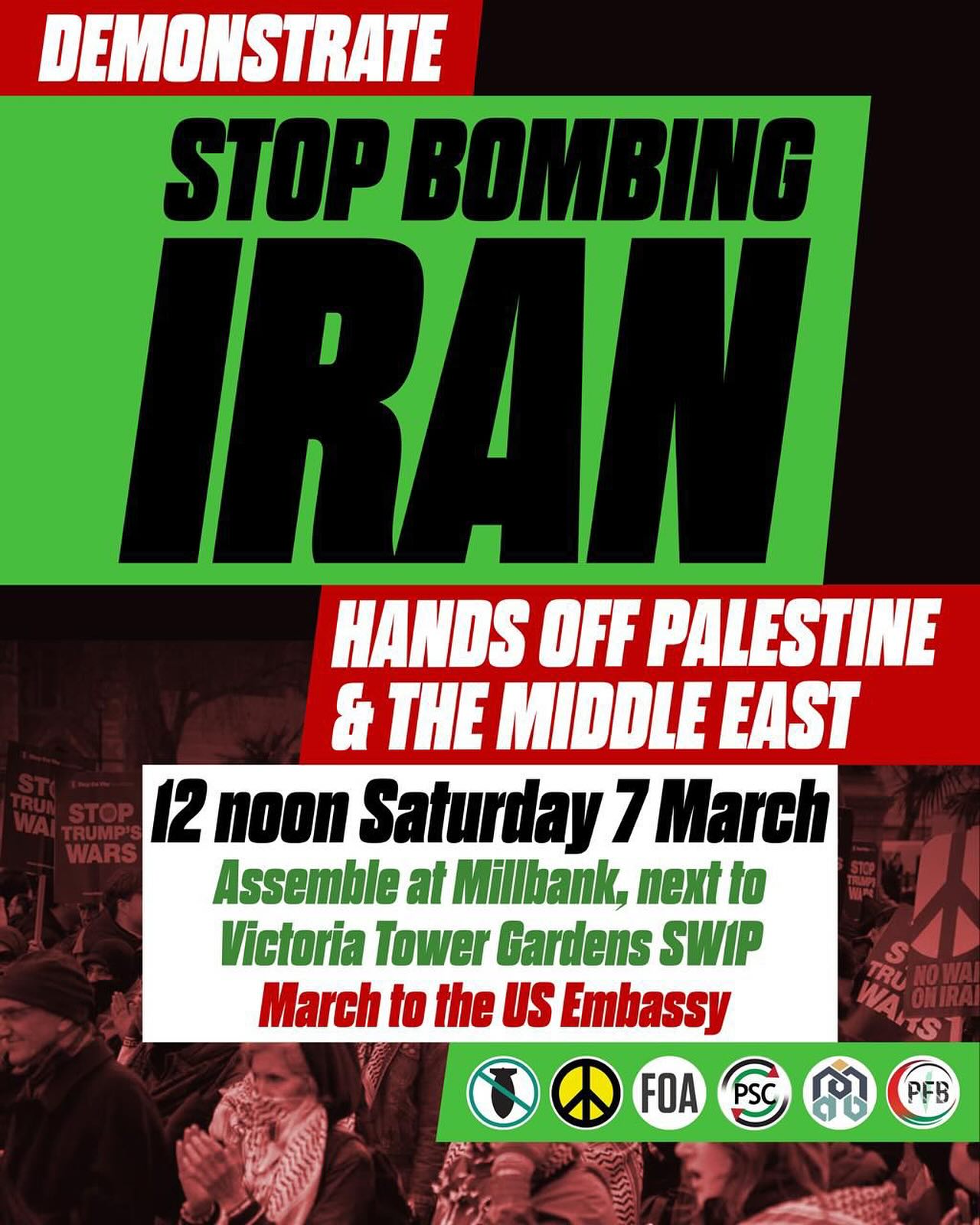
Thousands of demonstrators marched through central London on Saturday to protest recent U.S. and Israeli military strikes on Iran, calling for an end to military escalation and urging the British government not to deepen its involvement in the conflict.
The protest began near Millbank, close to the UK Parliament, and proceeded across the Thames toward the U.S. Embassy in Nine Elms. Protesters carried Palestinian and Iranian flags, beat drums, and chanted anti-war slogans as they moved through the streets under police supervision.
Turnout and Organization
Organizers estimated that between 20,000 and 30,000 people participated in the demonstration, though the Metropolitan Police placed the turnout at more than 5,000.
The march was organized by several prominent anti-war groups, including the Campaign for Nuclear Disarmament (CND) and the Stop the War Coalition, with support from pro-Palestinian organizations and trade unions.
According to organizers, the rally was arranged on short notice following the recent escalation in tensions between Iran, Israel, and the United States.
Protesters Call for De-Escalation
Speakers at the protest condemned the airstrikes and warned that continued military action could push the region toward a wider war.
Sophie Bolt, general secretary of the Campaign for Nuclear Disarmament, described the strikes as an “unprovoked illegal attack” and urged the British government to distance itself from the conflict.
“Our aim is to put maximum pressure on the government to stop supporting this war,” Bolt said, addressing demonstrators.
Members of the Stop the War Coalition also criticized the UK government’s stance, arguing that allowing British bases to be used by allied forces could indirectly draw the country into the conflict.
Voices From the Crowd
Participants came from diverse backgrounds, including activists, students, and members of diaspora communities.
One protester, Lela, an Iranian woman who has lived in London for three decades, said she joined the march out of concern for her homeland.
“I feel anxious and sad about what’s happening,” she said. “But seeing so many people here supporting peace gives me hope.”
Another attendee, Carla, an Italian resident in London, said she joined the demonstration because she fears the conflict could escalate into a global crisis.
“We need to fight for peace together,” she said. “People are worried about being dragged into another world war.”
Tim Newton, another participant, said he attended the protest for moral reasons, criticizing what he described as an unclear position from the British government.
Political Context
The demonstration reflects growing debate within the United Kingdom about the country’s role in the escalating tensions between Iran, Israel, and the United States.
Some critics argue that the UK’s cooperation with allied military operations could make Britain more directly involved in the conflict. Others contend that supporting allies is necessary to maintain regional stability.
A Wider Wave of Protest
The London march is part of a broader wave of anti-war demonstrations that have emerged internationally following the recent escalation in the Middle East.
Similar protests have taken place in several cities around the world, with demonstrators calling for diplomacy and warning of the dangers of a wider regional conflict.
As protesters gathered outside the heavily guarded U.S. Embassy at the end of the march, chants continued calling for peace and urging political leaders to pursue diplomatic solutions rather than military escalation.